Okay so this is the second part of me offering some advice on buying equipment. If you missed the first part you can read it
here. So now I am going to focus on the all important first bow and arrows.
Just to be clear I’m not sponsored by any archery shop or manufacturer. If I mention manufacturers or shops, its based on my experiences with them and their products. In short I don’t get any incentives or kickbacks to promote products on this site.
What kind of bow should I buy?
Buy one that feels right and comfortable. Just to be clear I’m not going to tell you to go out and buy “x” or manufacturer “y” as the choice should be yours based on your feelings. All I will do is give you some points to think about. Hopefully it will help and might cover topics you hadn’t considered.
By now you have hopefully had the chance to try a few different types of bows at your club. Ideally these should have been various draw weights and maybe different styles. Some you will have loved, others you may have hated. This might well influence your choice when it comes to buying a bow as you will probably have an idea of the draw weight you find comfortable and what feels right or comfortable when you draw it.
I tend to always recommend a simple 3 piece take down recurve to start with. This is based on personal experience. My first bow was a Samick Polaris, which was a three part take down of around 30lb draw weight. After a few months I bought some new limbs and this upped it to a 37lbs draw weight. This bow came with a wooden riser and limbs, though there are metal risers available at slightly more cost. I preferred the feel of the wooden ones.
So why this bow?
-
Relative cheap at about £60
-
I was familiar with the style as they were nearly identical to the ones I had been borrowing at the club.
-
It was easy to maintain.
-
It was a draw weight I was comfortable with.
-
I wasn’t needing one for hunting just for field archery. A simple recurve can work for target or field.
-
I could shoot it instinctively with wooden or metal arrows for HT BB (sorry Hunting Tackle or Bare bow) under the NFAS society or I could add sights.
-
Lots of people have experience of this type of bow so lots of advice out there.
-
Good to gain confidence with and return to potentially if I needed to.
These types of bows are relatively cheap (£55-£75 depending on where you get them), so if they don’t stick with the hobby it’s not such a huge investment. Also you might be able to pick one up from club member who has progressed.
The advantage of a takedown is the limbs can be upgraded to heavier poundage as archer develop their strength and skill (as I said I did this after a few months myself). Some shops giving a discount if you trade your old limbs in. It is worth noting that not all limbs fit all bows, something I will cover in more detail later.
Another advantage is a basic beginners recurve doesn’t require as much expert maintenance as a longbow, crossbow, compound or performance recurve, whilst still offering the archer a bow that works well. They can also last if you look after them. Sharon still has her first bow, which we use occasionally for coaching and its over 10 years old.

Sharon – shooting her first bow
What to think about
Hand grip – Bows risers will have different size hand grips, some you will like others you won’t. Some are quite thin or slender, allowing your fingers to wrap round the bow grip, others are wider so are more suited to longer fingers. So consider this if you have small or large hands. Some archers like a plastic or rubber grip on the riser, others prefer the feel of wood (I’m a wood fan. Which is why I like the wooden grip on my Samic Vision which for hose that don’t know is metal riser ).
I know many archers who retreat indoors over winter but archery can be a year round activity . so remember in winter months you may be wearing gloves, so you need to find a grip that feels right in your hand.
Draw weight – don’t overdo things at this stage and over-bow yourself. In fact don’t overdo things at any stage. Go for something that is comfortable to draw and shoot for an entire day. You can easily pick up some new limbs a few months down the line of a heavier draw weight.
Definition – Over-bowing this is when an archer has a bow of too high a draw weight for them to be able to draw it without struggling. It can result in personal injury or developing bad habits.
Partly due to our sedentary life style these days, i.e. too much tv and not enough exercise, many of the muscles you need to use in archery are under developed, so over bowing is a serious problem. In junior archers it can have a negative effect as their bones are still growing and developing.
Also remember you might take a break from archery for a couple of weeks due to work commitments, holidays etc and it doesn’t take long to lose muscle tone. So it is good to go back to a lighter if you develop bad habits or have an injury. I had a car accident a few years back and went back to light recurve to rebuild strength.

Taken on a very wet shoot
Risers – Metal risers are heavier than wood, carbon are lighter than both. Problem is carbon risers are very expensive (several hundred pounds for riser alone) and not ideal for a beginner. Give some thought to the physical weight of the bow once assembled not just the draw weight. If it is too heavy for you to be able to hold at arm length then you are not going to be to stable.
Just to complicate things more, risers also come in different sizes and can be combined with different limb lengths to make bows of varying lengths.
So this means you can have a 68 inch long bow comprising of
Short riser and long limbs.
Medium riser and medium limbs.
Long riser and short limbs.
Off an arrow rest or the shelf – this will depend on the bow and riser. Some are designed to be shot off the shelf others are designed to use an arrow rest.
For a first bow I think you really want to shoot off an arrow rest. Don’t go for expensive one. Plastic Hoyt super rest works fine (in fact Sharon uses one on her competition bow.)
Whats good to know?
Draw length is very important; in fact it’s vital as this will possibly restrict your choice of bows. So when you get to the shop have it measured. Most people after they have been shooting a while will find it has changed, lengthening slightly as you start to draw on your back muscles and they develop.
If you have a long draw over 29 inch then short bows (60 inch or less) may not feel as comfortable to draw. So you will probably be looking at a bow length of 68-70 inches.
This seems a good point to mention Bow length and stacking (stacking is the feeling of increased resistance in the smooth draw past a certain point)
Short bows tend to work for people with shorter draw lengths, Sharon loves small bows but her draw is only 25 1/2 inches. Whilst she is shooting a 66 inch flatbow currently she also likes shooting shorter bows. One is a custom made Blackbrook bow by Andy Soars. This comes in at 38lbs at 26 inches. Though the norm is to have bows rated at 28” draw, shorter bows often have a 26” rating too.
If I were to try to draw Sharon’s, the thing I notice is when I go past 26 inches. Don’t get me wrong it is a lovely bow to shoot but I can feel the difference as it starts to go past 26” because it has been designed and built for the best performance at 26”. She has another short bow, a Rebel at 54 inches rated 40lbs at 26 inches and 45lbs at 28 inches. She nicknamed this the Bitch as if you get anything wrong it punishes you. I think its a great name as I find it a bitch to draw to 28 inches.
Personal insight – As I have said my draw is 28 inches and all my bows are set up so I can draw smoothly up to my full draw, with an even increase in draw weight. I prefer the feel of a longer bow to draw so most of mine are 68 inches plus. If you have a long draw length then go for a longer bow 68 inches plus.
Never draw a bow that has been designed for another archer without their permission. You may find it has not been designed for lour draw length.
Bow draw weight
I was lucky enough to be shown the specifications that the scouting organisation in the UK use which provides some good guidance on potential draw weights for different age ranges. Its a pretty good starting point, though I have to stress these are only guide lines.
| Age Range |
Maximum bow weight at start of course |
Maximum draw weight by end of the course |
| Up to 12 yrs old |
14 lbs |
16 lbs |
| 13-14 |
16 lbs |
18 lbs |
| 15-16 |
18 lbs |
22 lbs |
| 17-18 |
20 lbs |
24 lbs |
| 19+ |
20 lbs |
24 lbs |
I tend to see most adult archers buy something round the 24lb to 32lb draw weight when they start. This will vary greatly on the individual and how much they have developed muscle strength and form. This may sound a bit sexist but ladies usually go for a slightly lighter draw weight bow of between 20 lbs and 26 lbs.
Budget – try and set yourself a budget you can afford and stick to it. It is very easy to spend more. After all the bows only one part you still need arrows., bow case and bits and pieces. This can be another downside of eBay and getting caught up in the excitement of bidding.
Club restrictions – may sound strange but some clubs, may have their own restrictions on the types of bows or arrows allowed. Some clubs are focused on one style of bow e.g. longbow only.
ILF or not?
Where takedown bows are concerned there are two types of riser and limbs ILF and bolt through.

Limb pocket and bolt not ILF
Bolt on limbs are generally inexpensive and work okay. I have several bows that use this technique to secure the limbs to the risers. The down side is there is not standard associated with these, meaning manufacturers can be slightly different in limb pocket size or limb width. This in turn means you can’t always swap limbs from one bow to another if the bows are different manufacturers.

ILF limb pocket on riser,
What is ILF?
ILF stands for international limb fit which is an industry standard. This means you can use any ILF limb with any ILF riser, which dramatically increases your selection available for you. In the past ILF risers have been more expensive but market forces are now pushing the price down and you can pick up some inexpensive ILF risers and limbs.
Between manufacturers limbs will feel different even if they are the same draw weight, and will release energy differently depending on what they are made from. I’ve shot 32lb limbs that have been faster and more efficient than 40lb limbs.

Underside of ILF limb showing pin that slides into riser
Don’t go for the first ones offered try a couple of different lengths and weights. You may find you go back to the first ones you tried but make sure you take the opportunity to try different ones.
Don’t go for heavy draw weight limbs initially, you can always upgrade later.
Also get the limbs and bow weight checked when you buy it. Just because the limbs say 28lbs doesn’t mean they are 28lbs with that riser, so its worth checking (A few years back I bought a Solo flatbow, rated and marked up at 40lbs at 28 inches, when I actually got it weighed it came in at 46lbs at 28 inches!!)
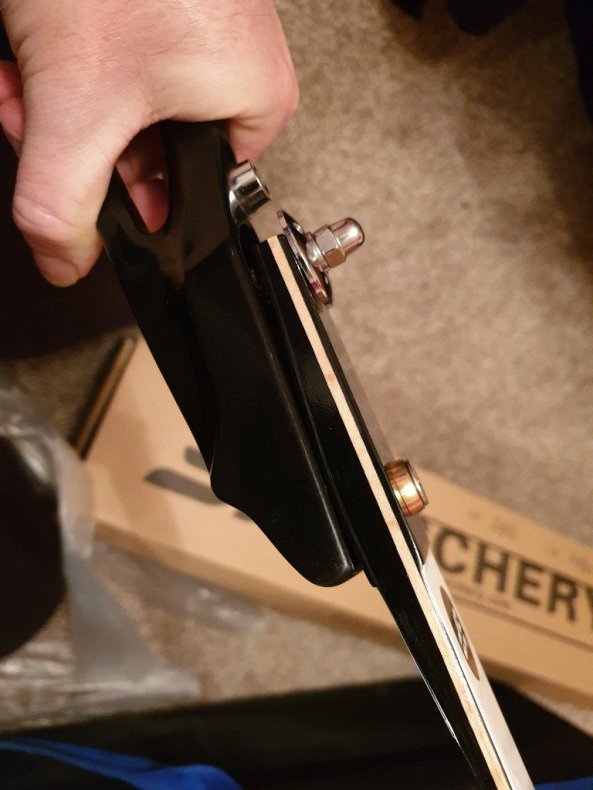
ILF limb in riser
Where should I buy my first bow from?
- NOT eBay – there is nothing wrong with eBay before anyone says anything. I simple would not advise anyone to buy their first bow off it, as you don’t know the history or condition of the bow. All you have to go on are a few pictures and a description, that can sometimes be less than accurate.
- Try before you buy – this is really, really important. Take the time and try bows of different draw weights, bow lengths and different manufacturers. You will find that some limbs will feel harder to draw than others, whilst some will feel smoother or shoot faster even though on paper they may be the same draw weight.
- Visit local shop – There are a number of archery shops doted round the country (Quicks, Merlin, Wales Archery, Bow Sports, etc) and all quality ones will give you the opportunity to try first and spend time with you.

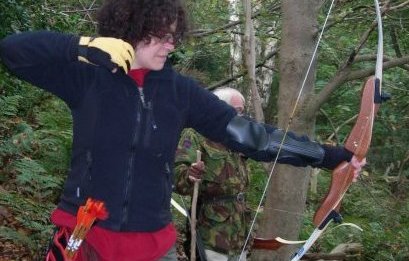
Me shooting my Samick Vision 1 in the rain
Personal insight – My first bow was bought from Quicks Archery and they were very helpful, spending time explaining everything. When I went to but my second recurve, this time from Merlin archery, I had a better idea of what I wanted and they too very willing to spend the time going over options. I recall trying several different limbs until finding ones that felt right.
If possible take an experienced person with you when looking to buy one ideally your coach or fellow club member. If I’m free I try and go with my students when they buy their first bow.
Couple of final points.
No that is not meant to be a pun as I was about to talk about arrows.
Arrows – for arrows I tend to recommend aluminium arrows for a beginner, they are durable and cheap. Easton Neos Beginners Alloy Arrow work well and come in variety of lengths and spines. I’ve used some Mybo cadets but haven’t been a fan of these as I haven’t found them as durable.

Easton Jazz
I tend to recommend avoiding carbon arrows at this stage even though you can get them for less than aluminium arrows . My reasoning is pretty simple. I have found some of the cheaper carbon arrows tend not to be as durable if they catch the side of a target or branch. This can result in a damaged arrow and carbon splinters are not nice or always easy to remove. you need to also consider if your club has any specific rules, as some clubs don’t allow archers to use carbon for a variety of reasons. They might be on a shared sport facility and not want to run the risk of carbon splinters.
The other main reason is carbon arrows tend to be a lot harder to find in the undergrowth with a metal detector as only the points and inserts for the nocks are metal. Sorry guys and girls, you will be looking for arrows when you first start, so don’t read this as me having a pop at your ability.
When it comes to arrow length, they should be longer than your draw length by normally a couple of inches. This allows for you overdrawing the arrow by accident and the arrow not coming off your arrow rest.
So having said I recommend aluminium arrows, my first arrows were wooden arrows and within a few months I had started making my own. This was a great move as it meant I learnt the skills to refletch any that lots fletchings, fit points / piles, etc.
Why did I go for wooden arrows? Simple I liked them, they felt more natural and appealing. Also I had broken a few and my coach ran a session on how to making wooden arrows which I really enjoyed.
You aren’t alone
Ask for advice from the archery community, your club members and of course your coach. After all they have a vested interest in you doing well. People will have had experience of bows, shops etc so its worth talking to others in your club. I tend to offer to go with any new student when they go to buy a bow.
I’ll try to put one last posting on what to consider after you have got your bow, maintenance or bow and string, bracing height and something on arrows.
As always, thanks for reading.